


Iran and the United States at a Crossroads | Will Trump Choose War or Continue the Blockade?
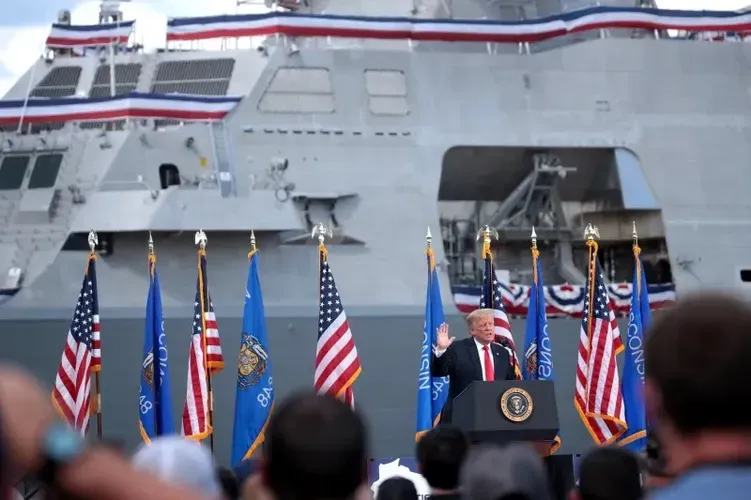
With negotiations showing little tangible progress, a third US aircraft carrier strike group has arrived in the Middle East. The situation bears striking similarities to the period preceding the 40-day war, with one key difference: Washington has already tested the military option against Iran once.
Political Desk: The arrival of a third US aircraft carrier in the Middle East, coinciding with a rise in maritime incidents in the Strait of Hormuz and reciprocal attacks by Iran and the United States, has heightened the risk of military confrontation. With negotiations still shrouded in uncertainty, Washington faces a choice between returning to a full-scale war and continuing its economic and military blockade.
Preparing for War or Applying Pressure?
The simultaneous presence of three aircraft carriers provides the United States with considerable capacity to expand its air and naval power in the region. Each carrier strike group comprises fighter aircraft, escort vessels and support systems, enabling it to participate in air operations, missile defense and the protection of maritime routes.
However, the arrival of a third carrier should not, by itself, be interpreted as evidence that Washington has made a definitive decision to launch a large-scale military operation against Iran. A report by the Institute for National Security Studies (INSS) indicates that the deployment and movement of carrier strike groups are also part of the US military's operational and rotational schedules. In fact, the USS Roosevelt's deployment to the region was initially linked to a mission to replace one of the carriers already stationed there.
Nevertheless, the simultaneous deployment of three carriers signals that the United States intends to keep its military option credible and readily available.
Rising Maritime Incidents in the Strait of Hormuz
The waters of the Strait of Hormuz remain a major flashpoint in the confrontation between Iran and the United States, with maritime incidents on the rise.
On Monday, the Iranian Army's Navy announced that another oil tanker had struck a naval mine in the eastern part of the Strait of Hormuz, triggering a fire. The Islamic Revolutionary Guard Corps (IRGC) also reported that two additional tankers had struck mines. According to the IRGC, the number of oil tankers damaged in the past two days has reached six.
Is Trump Looking for a Third Option?
The escalation in military movements comes as negotiations between Iran and the United States have also failed to make meaningful progress. While Qatari and Pakistani mediators have stepped up diplomatic efforts, shuttling between Washington, Tehran and Doha, Iran continues to insist on seven conditions as prerequisites for reaching an understanding and opening nuclear negotiations.
Mohammad Bagher Ghalibaf, Speaker of Iran's Parliament and head of the country's negotiating team, previously announced that Tehran had conveyed its conditions to Washington through the Qatari mediator and was now awaiting a US response.
On the other side, US President Donald Trump wrote on Truth Social last Thursday that Washington no longer needed an agreement with Iran. Trump has also removed Vice President JD Vance from the Iran portfolio and appears to have transferred responsibility for the issue to Secretary of State Marco Rubio.
Rubio, meanwhile, has outlined an approach that could be described as Washington's third option: maintaining the blockade and economic pressure without returning to a full-scale war or accepting an agreement that the US administration considers unsatisfactory.
At a closed-door Group of Seven (G7) meeting, Rubio reportedly said that Trump was choosing continued economic pressure over either resuming the war or accepting an unfavorable deal. He argued that if Washington could achieve its objectives through economic pressure, there would be no need for further military strikes.
In practice, this approach means preserving the current status quo: maintaining the blockade of Iranian ports, restricting the country's oil exports, putting pressure on commercial and financial networks, and sustaining a substantial US military presence in the region. Washington hopes that mounting economic costs will eventually force Tehran to accept US conditions.
How Will Iran Respond?
Iran, for its part, appears unwilling to accept this situation as a permanent reality. On Sunday, Ghalibaf told parliament that Iran would not remain in a state of neither war nor peace. He added that the path to an agreement remained open if the United States accepted Tehran's conditions.
This position, alongside warnings from Mohsen Rezaei and other Iranian officials about a broader response to any potential US attacks, suggests that Tehran wants to raise the costs of Washington's continued blockade and military pressure.
The central question, however, is whether Iran's response will remain limited to isolated strikes or whether it could escalate into a full-scale war.
Developments in the oil market add another layer of complexity to the potential consequences of the crisis. Despite the increase in maritime incidents, Brent crude remained at around $95 a barrel in Monday's trading, staying below the $100 threshold.
Reuters attributed this trend to market expectations of a global supply surplus, increased output from some producers and weaker demand from China. Nevertheless, shipping and maritime insurance costs remain elevated, while the risk of disruption in the Strait of Hormuz continues to provide an underlying source of support for oil prices.
War, Blockade or Limited Confrontation?
The central question now is how long the Trump administration can maintain a balance between economic pressure and limited military strikes without being drawn into another full-scale war.
Neither Washington nor Tehran has an option without significant costs. Maintaining the current state of neither war nor peace carries risks for both sides, while a broader military conflict would also come at a considerable price.
What remains clear is that the continuation of the naval blockade and the current standoff, without a clear diplomatic horizon, could eventually lead to direct confrontation.