


Qatar's Diplomatic Push From Washington to Paris: Are Tehran and Washington Moving Closer to a Deal?
EghtesadOnline: Qatar is stepping up its mediation efforts between Iran and the United States, bringing European and Persian Gulf Arab officials into the diplomatic process. Talks in Paris, a possible meeting in Doha and disagreements over the sequence of concessions are shaping efforts to end the war.
The war involving Iran has become a central issue in diplomatic discussions stretching from Washington to Europe and the Middle East. On the sidelines of the Group of Seven (G7) foreign ministers' meeting in Paris, the foreign ministers of Saudi Arabia and Qatar are holding talks with European counterparts about the conflict, amid growing reports that Arab and European governments are pressing US President Donald Trump to bring the war to an end.
Qatar Brings European and Gulf Diplomacy Together
Diplomatic efforts to address the conflict are continuing across the region and beyond, with the war involving Iran emerging as one of the main issues on the agenda of the G7 foreign ministers' meeting in Paris.
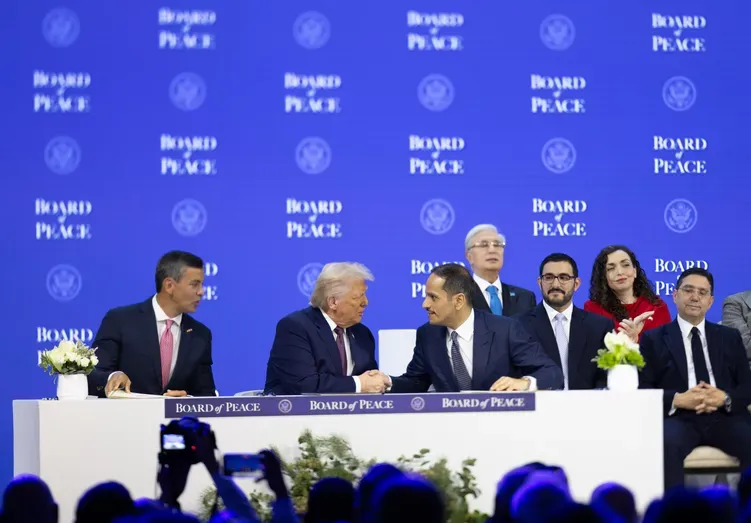
Particular attention has focused on the unexpected visit by Qatar's prime minister to Paris, which came just one day after his meeting with US President Donald Trump. The visit points to growing efforts by regional mediators and European powers to coordinate their positions on the future of the conflict.
Foreign ministers from the G7 countries — the United States, the United Kingdom, France, Germany, Italy, Canada and Japan — gathered in Paris on Monday, November 9.
The most significant diplomatic development on the sidelines of the meeting was the unannounced arrival of Mohammed bin Abdulrahman Al Thani, Qatar's prime minister and foreign minister.
According to reports, Qatar's top diplomat was expected to meet with the foreign ministers of France, Britain, Germany and Italy, as well as his Saudi counterpart.
France's Foreign Ministry said the Iran crisis, along with its security and economic consequences for the region and the international community, would be at the centre of the discussions.
Qatar is therefore seeking to convey the outcome of its discussions with Trump to European governments and Saudi Arabia, reinforcing its role as a key intermediary in the diplomatic process.
The significance of these efforts is heightened by growing European concerns over the economic and security consequences of a prolonged war. Countries such as France and Germany are particularly worried about disruptions to shipping through the Strait of Hormuz, rising energy costs and uncertainty in global markets.
Persian Gulf Arab states, meanwhile, are also seeking to prevent a wider military confrontation, given their exposure to potential attacks on energy infrastructure and commercial facilities.
Qatar, which has played a mediating role since the beginning of the crisis, is now seeking to continue those efforts in coordination with Saudi Arabia and major European powers.
A Possible Vance-Razai Meeting in Doha?
Alongside the diplomatic discussions in Paris, reports suggesting that US Vice President JD Vance could meet Iran's Mohsen Rezaei, secretary of Iran's Supreme National Security Council, in Qatar have drawn attention to possible developments in the structure of negotiations.
On Monday, Ibrahim Kalin, head of Turkey's National Intelligence Organization, said such a meeting could take place in Doha next week, describing it as an opportunity to advance negotiations.
According to Kalin, Turkey and other regional mediators are working on a seven-point agreement that would link sanctions relief and the release of Iran's frozen assets to Tehran's nuclear commitments and the resumption of cooperation with the International Atomic Energy Agency (IAEA).
However, an Iranian security official told domestic media that no such meeting had been scheduled, stressing that negotiations would not be on the agenda until the United States took practical steps.
Foreign Minister Abbas Araghchi subsequently said that no meeting of this kind had been planned.
Rezaei's response, meanwhile, was more ambiguous. He accused Washington of spreading fabricated reports about imaginary negotiations and called on the United States to accept Iran's seven conditions. However, he did not explicitly rule out negotiations or efforts to arrange such a meeting.
Who Will Make the First Concession?
According to a source familiar with the discussions, one of the main obstacles to a potential agreement is the sequence in which commitments would be implemented.
Reports suggest that one proposal under consideration by mediators would involve the United States lifting its naval blockade and releasing part of Iran's frozen assets in exchange for Tehran reopening the Strait of Hormuz, making certain nuclear commitments and resuming cooperation with the IAEA.
Details of a two-day proposal reportedly put forward by Iran and circulated in US media indicate that Tehran wants Washington to first end its naval blockade and release some of Iran's frozen assets.
Only after those steps, according to the reported proposal, would the way be cleared for reopening the Strait of Hormuz and beginning nuclear negotiations.
Washington, by contrast, continues to insist on nuclear guarantees and measures to prevent Iran from acquiring nuclear weapons.
The disagreement over which side should act first remains a central challenge for mediators seeking to turn diplomatic contacts into a concrete agreement.
Diplomacy Under the Shadow of Military Threats
The Qatari prime minister's appearance in Paris following his meeting with Trump, alongside Saudi Arabia's participation and consultations among European foreign ministers, highlights the growing involvement of regional and international actors seeking to influence the course of the conflict.
Nevertheless, it remains too early to conclude that an agreement is within reach.
Conflicting positions from Washington and Tehran, disagreements over the sequencing of commitments and the continued US military posture all suggest that a considerable gap remains between ongoing diplomatic efforts and a final settlement.
For now, Qatar's mediation efforts and the expanding diplomatic coordination between Persian Gulf Arab states and European governments offer potential channels for de-escalation. Whether those efforts can overcome the fundamental disagreements between Iran and the United States remains uncertain.