


White House Divisions Deepen as Trump Weighs Renewed Strikes on Iran | What Is His Strategy for Tehran?
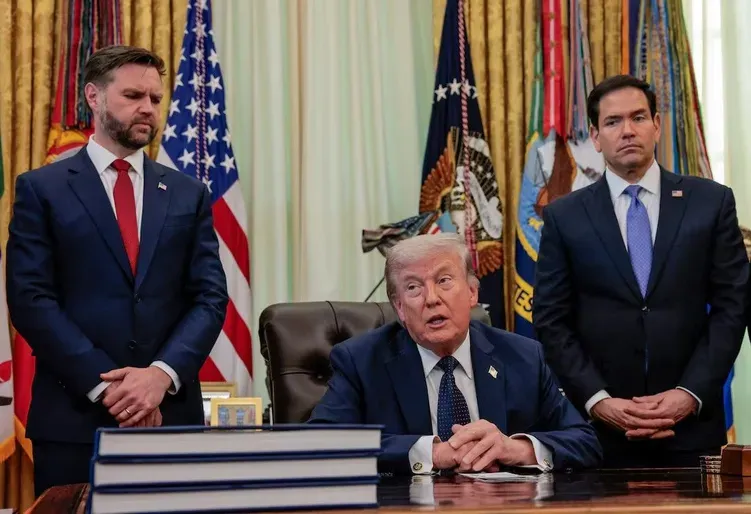
From sidelining JD Vance to keeping military action on the table, Trump's mixed signals, continued naval blockade and stalled diplomatic efforts are raising fresh questions about Washington's endgame in Iran.
Political Desk: President Donald Trump has sent increasingly contradictory signals over the future of the conflict with Iran, saying that Washington no longer needs an agreement with Tehran while simultaneously claiming that he could end the war immediately. At the same time, he has left the door open to renewed military action and maintained economic and maritime pressure on Iran.
The uncertainty has been compounded by reports of divisions within Trump's inner circle, particularly over the role of Vice President JD Vance, as well as continuing diplomatic efforts led by Qatar. Although Doha says it helped avert a potential US strike and secured a two-week window for mediation, there has been little indication that either Washington or Tehran is prepared to make significant concessions.
Maintaining the Blockade Instead of Escalating the War
Trump's latest comments on Iran suggest that his administration is seeking to sustain its maximum-pressure strategy without offering a clear timeline for ending the confrontation.
In interviews with American journalist Stephen A. Smith and a conservative media outlet, Trump claimed that he could bring the conflict to an immediate end but said requests from regional allies had influenced his decision to maintain military and economic pressure on Tehran.
Trump specifically identified Saudi Arabia as one of the countries that had called for maintaining the current approach. He also named Qatar, Kuwait, the United Arab Emirates and Bahrain as countries that, according to him, prefer Washington to continue its existing policy toward Iran.
Asked whether he would have attacked Iran without requests from these countries, Trump answered in the affirmative, adding that he remained prepared to authorize military action whenever necessary.
His remarks appear to serve two purposes. On the one hand, Trump is seeking to shift some responsibility for the continuation of the crisis onto Washington's regional allies, presenting continued pressure on Iran as a response to their security concerns rather than solely an American policy choice. On the other, his comments suggest that, for the White House, ending the war does not necessarily mean ending the confrontation with Iran.
The US president has also declined to rule out maintaining the naval blockade of Iran for as long as 26 months. He has made claims about Iranian inflation reaching 301% and alleged that the Iranian government is approaching a point at which it will be unable to pay its military personnel.
Trump has further portrayed the Islamic Republic as being on the verge of collapse. Regardless of the accuracy of these claims, his remarks indicate that Washington continues to view prolonged economic pressure as a central complement to its military strategy.
Qatar Keeps Mediation Channel Open
Despite the apparent diplomatic deadlock, indirect communication between Washington and Tehran appears to be continuing.
Israel's Channel 14 has claimed that Iran informed the United States through Qatar over the past 24 hours that it was unwilling to negotiate over its nuclear programme. According to the report, Doha subsequently relayed Tehran's position to American officials.
Meanwhile, reports that a Qatari government aircraft travelled to Tehran and returned approximately two hours later have fuelled speculation that indirect diplomatic contacts remain active.
The developments come as Qatar continues its mediation efforts. The Qatari prime minister has said that his country managed to prevent a last-minute attack on Iran, securing a two-week opportunity for diplomatic efforts to bring the two sides closer to an understanding.
However, with that window narrowing, there has been little evidence of a breakthrough. Both sides continue to maintain positions that leave limited room for compromise.
Is JD Vance Being Sidelined from Iran Negotiations?
Political tensions in Washington are also unfolding in the aftermath of the Republicans' midterm election defeat.
Politico has reported that Trump has sidelined Vice President JD Vance from the Iran negotiations. The reported decision came after Vance attributed the Republicans' electoral losses to the war with Iran.
The development could point to disagreements within Trump's inner circle over the costs and consequences of continuing the conflict.
Vance has been among the prominent figures in the administration associated with criticism of foreign military interventions and their financial and political costs. If Politico's report is confirmed, his exclusion from the Iran file could signal a reduced role for anti-interventionist voices in shaping Washington's approach to Tehran.
Neither the White House nor the vice president's office has publicly confirmed the reported move.
Nevertheless, the report coincided with a message Trump posted on Truth Social, in which he urged Vance to focus entirely on what he described as corruption in Democrat-run cities and states. Trump also declared that the United States no longer needed an agreement with Iran.
His remarks raise two possible interpretations. The first is that Trump has genuinely decided to abandon the diplomatic track. The second is that he is attempting to increase pressure on Tehran by publicly portraying Washington as no longer interested in reaching an agreement.
In either case, the statements add to uncertainty over the administration's negotiating strategy and the extent to which diplomacy remains part of its broader approach.
Military Action Remains an Option
With negotiations showing little progress despite mediation efforts, developments on the military front offer few signs of de-escalation.
The Islamic Revolutionary Guard Corps (IRGC) has said that it targeted an American early-warning radar system in Bahrain in retaliation for a US strike on a telecommunications tower in Sirik, Hormozgan province.
American and Bahraini officials have not publicly commented on the IRGC's claim. Iranian government sources, meanwhile, have said that the US target in Sirik had a military function.
Separately, Israel's Channel 13 has reported that, according to an Israeli military assessment, Israel would prefer to participate in any renewed US military operation against Iran if Trump decides to launch one. The assessment reportedly suggests, however, that there is no immediate need for such an operation.
Israeli Prime Minister Benjamin Netanyahu has also met with Gadi Eisenkot following a letter from the latter calling for restraint and warning against escalatory actions until a new government is formed.
The meeting has fuelled speculation about coordination over Israel's potential involvement in a future American strike on Iran, although its specific agenda has not been publicly established.
Taken together, these developments suggest that the possibility of renewed military confrontation remains part of the strategic calculations of both sides.
A Divided White House and an Unclear Endgame
The latest developments suggest that the Trump administration has yet to establish a coherent and clearly defined strategy for ending its confrontation with Iran.
On the one hand, Trump has suggested that a change in Iran's political structure is necessary to avoid what he would consider a failure to achieve Washington's objectives. On the other, he has declared that the United States no longer needs an agreement with Tehran.
These positions point to an unresolved question about the administration's ultimate objective. Securing a nuclear agreement, changing Iran's behaviour and transforming its political system are three fundamentally different goals, each carrying distinct requirements, risks and costs.
There is also a significant obstacle on the Iranian side. Officials in both Washington and Tehran continue to speak in terms of the other side accepting their conditions, suggesting that neither government is currently prepared to make substantial concessions.
As a result, an immediate agreement appears unlikely. Instead, the two countries may remain locked in a prolonged period of strategic uncertainty: negotiations conducted under the shadow of military confrontation, alongside maritime restrictions, economic sanctions and continued tensions surrounding the Strait of Hormuz.
For now, Trump's strategy appears to combine diplomatic pressure, economic coercion and the threat of renewed military action, without a clearly articulated path toward a lasting settlement.