


Elon Musk Signals Potential SpaceX–Tesla Merger as AI Empire Takes Shape
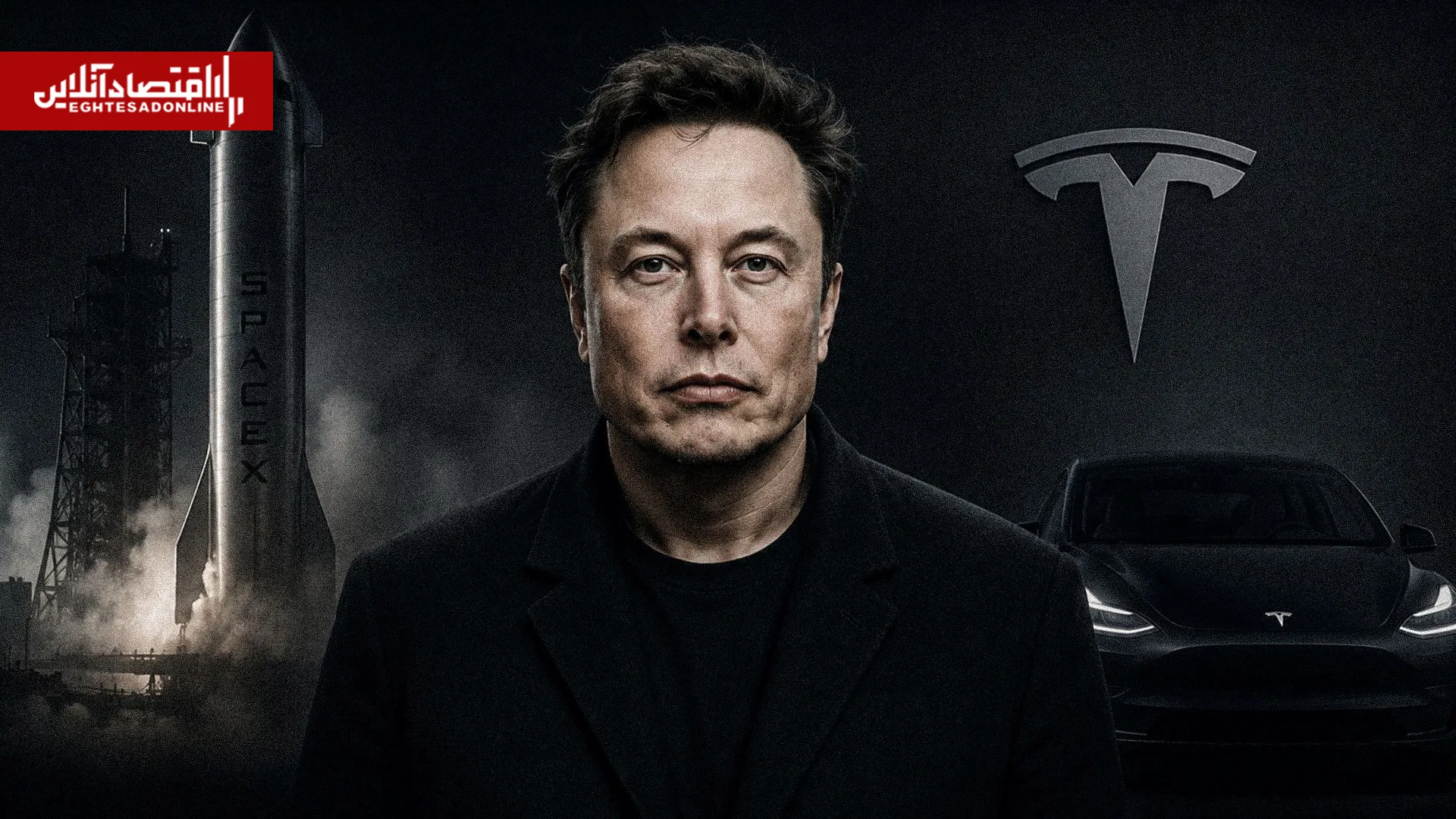
EghtesadOnline: Elon Musk has endorsed the idea of merging SpaceX and Tesla, raising the prospect of a technology powerhouse spanning artificial intelligence, robotics, semiconductor manufacturing, satellite communications and space exploration. The proposal comes as SpaceX reports a sharp increase in AI revenue and stronger-than-expected quarterly profits, although a merger remains uncertain.
Elon Musk said on Tuesday, October 20, 2026, that a merger between SpaceX and Tesla could be a good idea. He also confirmed that the two companies had established special committees to examine the possibility of a merger and the potential terms of a deal. Following the remarks, SpaceX shares rose 8% in after-hours trading, while Tesla shares gained 1.8%.
The comments come as SpaceX reports a profit for the first time since entering the public markets, while its artificial intelligence business records substantial revenue growth. Musk has also forecast that the company's annual recurring revenue could reach between $500 billion and $1 trillion by the end of 2027, a target linked to rising demand for data-center capacity amid the AI boom.
Musk had previously raised the possibility of a merger, pointing to the growing overlap between the two companies' activities. Speculation about a potential SpaceX acquisition of Tesla has intensified in recent weeks. Barclays also suggested last week that an agreement could be announced before Tesla's annual meeting in December.
Speaking during a conference call with investors, Musk said: "I think it's a good idea, but the decision-making is really up to the special committees of each company."
He added that he could not participate in the committees' negotiations because of potential conflicts of interest. The committees consist of independent directors and, according to Musk, were established at the request of shareholders. Shareholders would ultimately have to approve any potential transaction.
Musk believes a merger could offer significant advantages, particularly in the development of superintelligent software, chip design, the Terafab chip-manufacturing project, robotics, the transportation of payloads into Earth orbit and satellite communications.
However, he cautioned that the merger should not be considered a certainty. The special committees have yet to agree on the terms of a transaction, and they may ultimately fail to reach an agreement altogether.
According to a person familiar with the matter who spoke to Reuters, discussions began in recent weeks and could eventually lead to SpaceX acquiring Tesla. The person, who requested anonymity, said Tesla was working with an investment bank to evaluate the discussions.
Musk owns nearly one-fifth of Tesla and slightly less than half of SpaceX. Analysts believe that a merger could further consolidate his control over the combined entity.
AI Revenue Surge: SpaceX Is No Longer Just a Space Company
SpaceX revenue rose 161% year over year to $14.58 billion in the three months ended September 30. During the same period, revenue from its AI business increased nearly tenfold to $7.56 billion.
Most of that revenue came from renting computing capacity at data centers to AI developers, including Anthropic, Google, a subsidiary of Alphabet, and Reflection AI, rather than from selling SpaceX's own proprietary AI models.
The third-quarter results provide the clearest indication yet that SpaceX's heavy investments in artificial intelligence are translating into actual revenue. However, the cost of developing computing infrastructure has also risen sharply.
Capital expenditures nearly tripled to $19.6 billion. SpaceX Chief Financial Officer Bret Johnsen said the company expected capital expenditures to reach between $35 billion and $40 billion in the fourth quarter.
Will Rhind, chief executive of asset-management firm GraniteShares, said SpaceX had delivered revenue performance consistent with the market's optimistic expectations. He added that artificial intelligence had become the central focus of the company's growth story, with computing contracts signed earlier in the year converting into revenue faster than expected.
SpaceX's AI business encompasses Grok, the social media platform X and its expanding data-center operations. The segment became profitable in the third quarter, after recording a loss in the same period last year.
SpaceX reported net income of $4.4 billion for the quarter, compared with a net loss of $1.1 billion a year earlier and analysts' expectations for net income of $1.57 billion.
Adjusted earnings per share reached 45 cents, according to calculations by IBES, well above the analysts' average forecast of 13 cents.
Starlink Exceeds Subscriber Forecasts, but Revenue per User Declines
SpaceX's satellite internet business, Starlink, continues to expand its subscriber base. Growth has been supported by an increase in satellite launches and the expansion of services for consumers, businesses, airlines, maritime transport operators and governments.
Starlink's subscriber count reached 13.6 million in the third quarter, exceeding analysts' forecast of 12.19 million.
However, the business's expansion has coincided with a decline in average monthly revenue per subscriber. The figure fell from $99 in 2023 to $69 in the third quarter of 2026, a trend associated with expansion into more countries and the introduction of lower-priced service plans.
SpaceX has previously said that expanding its services beyond wealthier countries could further reduce average revenue per user over the long term.
Starship and Terafab: The Infrastructure Behind Musk's Future Empire
Starship, SpaceX's next-generation reusable launch system, has yet to enter commercial service. The system is expected to enable the deployment of higher-bandwidth Starlink satellites and AI computing infrastructure in Earth's orbit.
SpaceX's ability to turn Starship into a reliable, fully reusable launch vehicle will be critical to the company's long-term strategy. However, its space business, which includes commercial launches, government missions and Starship development, continues to face substantial costs and uncertainty.
Meanwhile, Musk said the Terafab project, a joint SpaceX–Tesla investment in chip manufacturing, would likely produce its first test chip in May or June 2027. The project aims to begin mass production by the third quarter of 2028.
Combining chip-manufacturing capabilities, computing infrastructure, satellite internet, robotics and space technology is among the main reasons Musk has cited in support of a merger between the two companies.
Nevertheless, until the terms of a transaction are established and shareholder approval is secured, a SpaceX–Tesla merger remains a possibility rather than a certainty.