


Trump’s Big Decision on Iran: Deal or Attack?
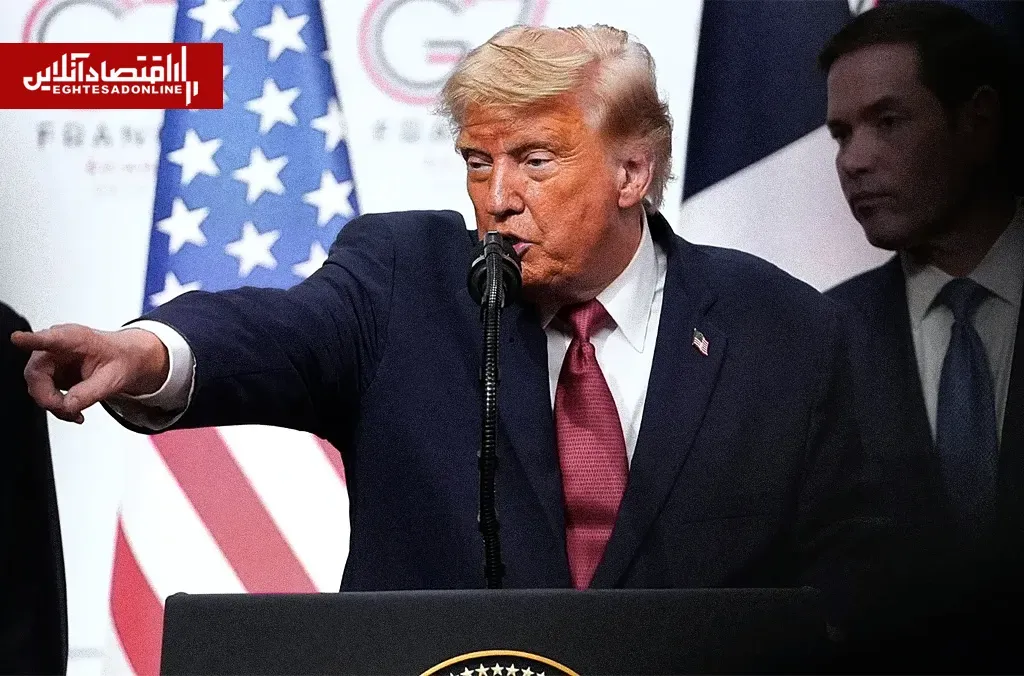
EghtesadOnline: Signs of a possible military confrontation in the region have grown stronger, while diplomatic efforts to ease tensions have also intensified. Unofficial reports suggest that Abbas Araghchi made a brief stop in Qatar during his trip to the United States, while Donald Trump has claimed that he is facing a major decision regarding Iran.
Politics Group: Amid renewed tensions between Iran and the United States, Donald Trump has spoken of a “big decision” regarding Iran. On one side, Qatari officials say they are working to revive negotiations and have received indications that Washington is interested in reaching a deal. On the other, Tehran has warned of a possible new attack, while the U.S. military presence in the region has simultaneously intensified.
Could the “big thing” Trump has referred to be a new agreement, or is the U.S. president preparing public opinion for a new phase of attacks and war against Iran? Have Arab leaders given Trump the green light for another attack on Iran?
From Warnings of a Deal to Threats of Attack
Trump has once again spoken about various options regarding Iran in recent days. According to published reports, he said in an interview with Fox News that he is considering several options, ranging from economic pressure and a deal to a very large-scale military action. He even claimed that the option of “wiping out Iran” is on the table. He also said that “something big” could happen regarding Iran soon.
Donald Trump is known for sending mixed signals. In the Iran file, he has repeatedly used military threats to increase pressure for negotiations, while at different points also speaking of the possibility of a deal, even as he has ordered military attacks. However, the current situation differs from previous periods because these threats are being made while the Iran-U.S. war has been ongoing for months, with tensions over the Strait of Hormuz also intensifying in recent weeks.
Therefore, the main difficulty in interpreting Trump's remarks is that threats and negotiations are not necessarily two opposing tracks in his strategy. Washington may use the threat of an attack to raise the cost of rejecting a deal while keeping the diplomatic channel open at the same time.
Signs of Negotiations Stuck in a Deadlock
In this context, Qatar's Foreign Ministry spokesperson said that Doha has been conveying various views and proposals between Iran and the United States for about two weeks in an effort to resume negotiations. Majed Al Ansari also said that Qatar had received confirmations from U.S. officials that Washington wants to reach a deal.
It has been reported that Abbas Araghchi also made a brief stop in Qatar during his trip to the United States.
These developments are consistent with recent reports of continued indirect contacts between Iran and the United States. Qatar and Pakistan remain active as mediators, while Tehran has conveyed conditions for returning to negotiations to Washington through the Qatari mediator. Some unofficial reports have even suggested that a plane flew from Iran to Qatar, potentially carrying an Iranian official to deliver a message.
Mohsen Rezaei has also recently spoken about ending the war on all fronts, lifting the naval blockade and releasing frozen assets as conditions for returning to negotiations. Iranian officials had previously said that the Strait of Hormuz would not return to its pre-war status. However, some reports have claimed that Iran proposed joint management of the Strait of Hormuz with Oman in a new offer to the United States. Washington, meanwhile, continues to use economic and naval pressure as leverage to force Tehran to accept its conditions, while Trump has said he will not accept a deal that he considers “complete” only if it meets his standards.
Nevertheless, Trump has expressed his willingness to meet with President Pezeshkian, and the United Nations General Assembly will be highly significant in the course of developments between Iran and the United States.
Negotiations Under the Shadow of War
On the other side of the equation, signs of a possible military attack remain prominent. The Khatam al-Anbiya Central Headquarters, which is responsible for managing the war, has said that it has information indicating that the United States is preparing to resume attacks, and has warned the U.S. and regional countries about the consequences of a possible attack. Earlier, reports emerged that Trump had consulted Arab leaders about Iran, which the U.S. president confirmed. Iran has therefore described the behavior of the Gulf states as contradictory and warned them.
After the U.S. and Israeli attacks on Iran began and the consequences of the war for Gulf countries became clear, the leaders of these states sought to contain the conflict. However, as the situation has dragged on, some of these countries—particularly Bahrain, the UAE and Saudi Arabia—may have called for renewed U.S. action. This is especially the case after Yemen's Ansarullah managed to consolidate its control over the strategic Bab al-Mandab Strait by gaining control of Yemen's western coast.
At the same time, the United States has warned its citizens in several countries across the region about the possibility of a sudden escalation in tensions. Experience has also shown that Trump's insistence that the situation remains similar to previous weeks increases the possibility of a sudden change in circumstances.
From this perspective, the presence of U.S. aerial refueling aircraft mentioned in Iranian reports could be part of operational preparations. However, even such preparations do not necessarily mean that an attack is imminent. Military forces may be deployed for deterrence, to increase negotiating pressure, or to prepare for various scenarios. Trump has repeatedly canceled attacks on Iran at the last minute.
War or Negotiations?
Under the current circumstances, the available evidence points to a dual-track situation. Washington is simultaneously maintaining its military leverage while testing the possibility of a deal. A similar situation exists in Tehran. On the one hand, Iran is conveying its conditions through mediators, while on the other, it is preparing for the possibility of an escalation in the war. The secretary of Iran's Supreme National Security Council has said that Iran is prepared for a “decisive war” and has also announced that Iran's conditions have been conveyed. Parliament Speaker Mohammad Bagher Ghalibaf and the negotiating team have also criticized those calling for an “endless war,” saying that “we must both fight and negotiate.”
This situation reflects the current deadlock. The United States has significant military and economic tools at its disposal, but the experience of recent months has shown that military pressure alone has not led Iran to accept Washington's conditions. Iran, meanwhile, faces serious limitations under the blockade and economic pressure, but still has tools to impose regional costs and disrupt energy markets and, consequently, the global economy. Iran has also demonstrated that it can use missile and drone attacks to target U.S. positions and energy infrastructure in the region in an asymmetric manner.
Under these circumstances, if Trump genuinely intends to use the threat of military action to extract concessions in negotiations, more signs of Washington's position on Iran's conditions, as well as the level of the U.S. military presence in the region, should emerge in the coming days. In particular, Araghchi's presence in New York could play a role in preventing a conflict and building regional consensus against Iran.
Conversely, if a decision to attack has been made and Arab states have also given their green light, an exit from mediation channels, along with a more visible increase in troop deployments and official warnings, could signal that Iran and the United States are moving toward another war.