


Eisenkot Faces Uphill Battle to Form Israel’s Next Government as Netanyahu’s Political Future Hangs in the Balance
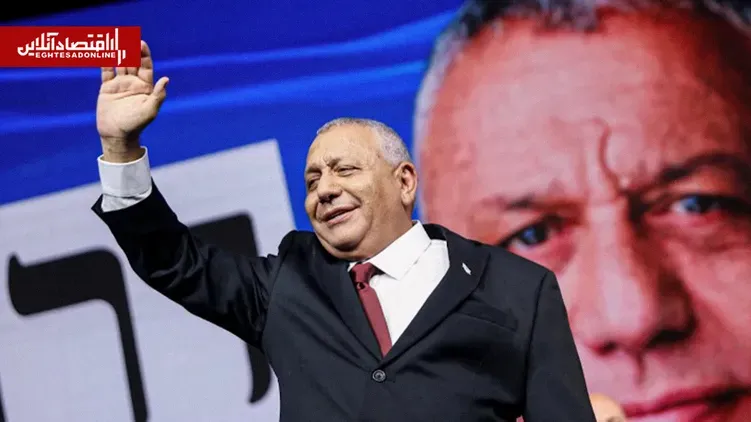
EghtesadOnline: Israel’s former military chief has been tasked with forming a new government, potentially bringing an end to Benjamin Netanyahu’s 19 years in power across multiple terms. But with no clear parliamentary majority, the path to replacing the longtime prime minister remains uncertain.
With Gadi Eisenkot appointed to lead efforts to form Israel’s next government, Benjamin Netanyahu has moved one step closer to the end of his premiership. Netanyahu has served as prime minister for a total of 19 years across non-consecutive terms and has spent roughly three decades at the center of Israeli politics.
However, after three years of war and the failure of the two main political blocs, particularly Netanyahu’s camp, to secure a parliamentary majority in the elections, Israeli President Isaac Herzog has tasked Eisenkot, leader of the Yashar party, with forming the next government.
Eisenkot, however, faces a difficult challenge. Despite leading the opposition to Netanyahu, he has just 28 days to assemble a governing coalition, and securing the necessary parliamentary support will not be easy.
The political uncertainty comes amid concerns that Netanyahu could seek to reshape the domestic political landscape through military action, including the possibility of launching another attack on Iran.
Why Was Eisenkot Chosen to Form the Government?
Herzog's decision came after neither of the two main political blocs managed to secure the 61 seats required for a parliamentary majority in Israel's 120-member Knesset.
Netanyahu's Likud party remained the largest single party in parliament, winning 27 seats. However, the combined religious and nationalist parties in his coalition secured only 53 seats.
Meanwhile, the four-party opposition alliance led by Eisenkot won 48 seats, while two lists representing Arab parties collectively secured 19 seats.
During consultations with the president, representatives holding 67 parliamentary seats expressed support for Eisenkot to lead government formation. By comparison, representatives of 46 seats backed Netanyahu, while a seven-member parliamentary faction declined to endorse either candidate.
As a result, Eisenkot secured the first opportunity to form a government, despite lacking an independent parliamentary majority.
The Difficult Path to Forming a Government
However, parliamentary support for Eisenkot's mandate does not necessarily mean that all supporting parties are prepared to join his government.
Arab parties hold a potentially decisive position. Their combined 19 seats could provide the parliamentary backing needed to establish a government. However, Eisenkot and several of his Jewish political allies have previously opposed forming a formal coalition with these parties.
One possible solution is the formation of a minority government supported externally by Arab parties. Under this arrangement, Arab factions would not formally join the governing coalition or cabinet but would provide support in confidence votes and on key parliamentary issues.
Such an arrangement would nevertheless require agreements on sensitive issues, including security policy, the war in Gaza and the role of Arab parties in political decision-making.
Another option for Eisenkot would be to seek support from ultra-Orthodox and other religious parties. However, this route is also complicated by disagreements over military service exemptions and proposed reforms.
One of Eisenkot's central political promises is to end exemptions from military service for ultra-Orthodox Jewish men, a position that directly conflicts with the demands of religious parties.
Netanyahu's Response to the Electoral Defeat
Netanyahu, meanwhile, has not disappeared from the political scene.
In his initial reactions, he has attempted to frame his coalition's failure to secure a majority as a matter of national security, arguing for the need to establish a national unity government.
He has criticized the possibility of forming a government with the support of Arab parties, describing such an arrangement as a threat to Israel's existence. He has also called on Eisenkot to cooperate with Likud.
That proposal is highly unlikely to be accepted by Eisenkot.
Netanyahu therefore appears to have two main options.
The first is to try to undermine the opposition alliance by highlighting internal disagreements and persuading some parties or individual lawmakers to switch sides.
The second is to remain in office as caretaker prime minister while negotiations continue. If Eisenkot fails to form a government, Netanyahu could potentially use the next opportunity to attempt to assemble a coalition himself.
What Could a Change of Government Mean for Iran?
The key question is how Israel's political developments and the possibility of a new prime minister could affect Iran.
It is important to distinguish between Eisenkot's political positions and the possibility of a fundamental change in Israel's strategy toward Iran.
Although Eisenkot differs from Netanyahu on domestic issues and the way the government should be run, his military background suggests a hardline approach to security matters.
During his tenure as chief of staff of the Israel Defense Forces from 2015 to 2019, Eisenkot pursued the so-called Dahiya Doctrine, an approach emphasizing the destruction of infrastructure in areas controlled by Hezbollah.
He has also called for an end to Hamas rule in Gaza and the destruction of the group's military capabilities. In addition, he has opposed the establishment of an independent Palestinian state.
Consequently, there is little fundamental difference between Eisenkot and Netanyahu regarding Iran or the view that Tehran represents Israel's primary security threat. The main distinction lies in how they approach that threat.
Eisenkot has argued that setting regime change as an objective of a war against Iran would be a mistake. Instead, he believes Israel should focus on striking Iran's nuclear and missile infrastructure.
Netanyahu, by contrast, has repeatedly identified regime change in Iran as one of his objectives.
Another important difference concerns relations with Washington. Eisenkot has advocated greater Israeli military freedom of action in relation to the United States. Netanyahu, meanwhile, has relied heavily on American support for military operations and has generally avoided major operations without Washington's approval.
Netanyahu and the Possibility of Another Attack on Iran
Although Netanyahu may be approaching the end of his political career, he remains prime minister and retains decision-making authority until a new government is formed and power is transferred.
Under these circumstances, escalating tensions with Iran could allow him to bring national security back to the center of public debate and shift attention away from domestic political divisions.
However, launching another conflict with Iran would not be without risks for Netanyahu.
A large-scale military operation could trigger Iranian retaliation, expand the conflict to additional fronts and increase pressure on Israel's economy and security infrastructure.
Furthermore, any major military action would depend on Washington's calculations and the extent of support from the White House.
What Happens Next?
Eisenkot has 28 days to form a government, with the possibility of a further 14-day extension.
If Netanyahu loses power, he could also face renewed attention to his ongoing legal cases, while returning to the premiership may become increasingly difficult.
A new government would not necessarily bring a fundamental change in Israel's foreign policy strategy, but it could alter the way that strategy is implemented.
If Eisenkot fails to form a government within the allotted period, another candidate will be given the opportunity. Netanyahu could potentially be the next person tasked with the process.
If all candidates fail to form a government, Israel would face another early election, prolonging the country's political uncertainty.