


Trump’s Welcome for Xi Highlights a Shifting U.S.-China Balance
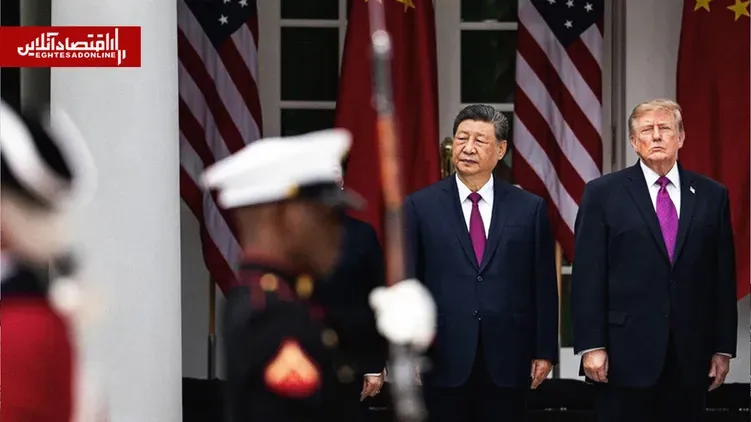
EghtesadOnline: Donald Trump gave Chinese President Xi Jinping an unusually elaborate welcome during his state visit to the United States, combining extraordinary diplomatic ceremony with a display of American military power. The spectacle reflected the shifting balance of power between Washington and Beijing and the two countries’ efforts to manage their strategic rivalry.
Political Group: Donald Trump staged an exceptionally grand welcome for Xi Jinping during the Chinese president’s state visit this week, with Washington deploying the full range of ceremonial resources to honor its guest. Xi and his delegation would have noticed this from the moment they arrived at Joint Base Andrews on September 23.
A U.S. military honor guard lined the red carpet, while Trump and First Lady Melania Trump stood beside the presidential aircraft stairs to greet Xi and his wife, Peng Liyuan, as they disembarked. A boy and a girl presented the couple with flowers, military bands played the national anthems of both countries, and a 21-gun salute was fired. The ceremony concluded with two B-1 bombers flying overhead.
Such a high-level welcome, particularly the president and first lady personally receiving a foreign leader at the airport, was reportedly the first of its kind in more than 60 years.
An even more elaborate ceremony was held at the White House on the morning of September 24 , where an honor guard of 479 military personnel from different branches of the U.S. armed forces welcomed Xi. Trump accompanied Xi during an inspection of the honor guard in the Rose Garden before the Chinese president watched a military display that culminated in a flyover by a B-2 Spirit stealth bomber and four F-22 Raptor fighter jets.
America’s Red Carpet Backed by Military Power
Such a high-level welcome, particularly the president and first lady personally receiving a foreign leader at the airport, was reportedly the first of its kind in more than 60 years. The unprecedented nature of the gesture clearly reflects the changing balance of power between China and the United States.
Analysts have observed that, compared with Trump’s unexpected use of social media ahead of the China-U.S. leaders’ meeting in Busan last October to promote the idea of a “G2” relationship based on equality between the two countries, the Washington summit effectively turned the concept of a G2 into a public spectacle for the world to see. Some U.S. scholars have also complained that White House protocol on this occasion was disproportionately tilted in China’s favor.
The inclusion of strategic bomber flyovers in the welcome ceremony was also unusual, highlighting Trump’s particular disregard for conventional protocol. The B-1 and B-2 strategic bombers are among the most important heavy offensive weapons in the U.S. military, while the B-2 is regarded as one of the crown jewels of the American arsenal and among the world’s most advanced strategic bombers.
Chinese President Xi Jinping and U.S. President Donald Trump attend a military parade in the Rose Garden of the White House in Washington, D.C., on September 24, 2026.
Seven B-2 bombers formed the main strike force in the U.S. military’s “Operation Midnight Hammer,” which targeted Iran’s underground nuclear facilities in June. Deploying such a weapon in a welcoming ceremony carried a powerful element of military signaling. From Trump’s perspective, perhaps it was no different from a wealthy family displaying its luxury cars. But the move also brings to mind the Chinese saying: “First courtesy, then force.”
Courtesy accompanied by power, and power exercised within the framework of courtesy, can both be used to describe China-U.S. relations. Here, “power” can be understood broadly, encompassing the two countries’ intense competition across multiple areas as well as their rivalry in hard power.
Da Wei, director of the Center for International Security and Strategy at Tsinghua University, said: “China’s approach to relations with the United States is changing. It is shifting from rejecting the American framework of defining the relationship as one of competition to accepting that the nature of China-U.S. relations is competitive.”
From this perspective, the White House’s exceptional welcome and military display could serve as an appropriate symbol of the bilateral relationship: intense competition combined with mutual respect, with neither side willing to fall behind the other while both broadly seek a stable relationship.
Beijing Embraces Managed Competition
Ahead of the summit, the messages publicly expressed by Chinese scholars were generally positive. Da Wei, director of Tsinghua University’s Center for International Security and Strategy, highlighted an important shift in an article published earlier this month in Foreign Affairs: China’s approach to relations with the United States is changing. Beijing is moving from rejecting the American framework of defining the relationship as one of competition toward accepting that competition is inherent in the bilateral relationship.
Ultimately, if Beijing viewed Washington as an ally or partner, there would be no need to make “strategic stability” the overarching goal of bilateral relations. Such a goal is needed between rivals. Da also argued that Beijing’s willingness to accept a relationship that requires competition to be managed rather than eliminated reflects China’s growing confidence in viewing itself as an equal competitor to the United States. That confidence could, in turn, encourage China to exercise greater restraint in managing its relationship with Washington and contribute to greater bilateral stability.
Indeed, many Chinese scholars believe that the China-U.S. summit in Washington could mark the beginning of a relatively more stable period in bilateral relations. Major issues and fundamental challenges between the two countries—including trade, technology and potential flashpoints in the Taiwan Strait—remain unresolved, and fresh shocks and volatility are likely to emerge.
Renewed emphasis on “strategic stability” amid intense China-U.S. competition may be the most significant outcome of the Trump-Xi summit in Washington.
At the same time, China and the United States both understand that neither can defeat, transform or separate itself from the other. Following intense confrontations over tariffs, semiconductor technology and rare earths, Trump’s approach toward China has also become more pragmatic.
Efforts to Stabilize a Volatile Rivalry
In his Foreign Affairs article, Da wrote: “A confident Beijing and a pragmatic Washington can coexist.”
This certainly does not mean that China-U.S. relations will become free of competition or that rivalry will decline. On the contrary, the two countries will continue to compete intensely across virtually every domain, and great-power competition is likely to continue for a long time. However, the downward trajectory of bilateral relations over the past eight years may at least temporarily come to a halt. Some scholars have described the situation this way: “There is no reason for optimism, but there is also no reason for pessimism.”
Renewed emphasis on “strategic stability” amid intense China-U.S. competition may be the most significant outcome of the Trump-Xi summit in Washington. A dramatic return to the state of relations that followed Richard Nixon’s visit to China in 1972 is unlikely, but relations between the two countries could gradually stabilize.
Although the summit is unlikely to produce a major, decisive breakthrough, the two sides can still pursue positive outcomes in areas including trade, purchases of agricultural products and liquefied natural gas, and cooperation in artificial intelligence. Such progress would allow the summit to conclude successfully, fulfill its broader diplomatic purpose and preserve a more positive atmosphere between the two countries.
Source: ThinkChina