


Did Israel’s Plan to Break Iran’s Internet Censorship Lock Finally Begin?
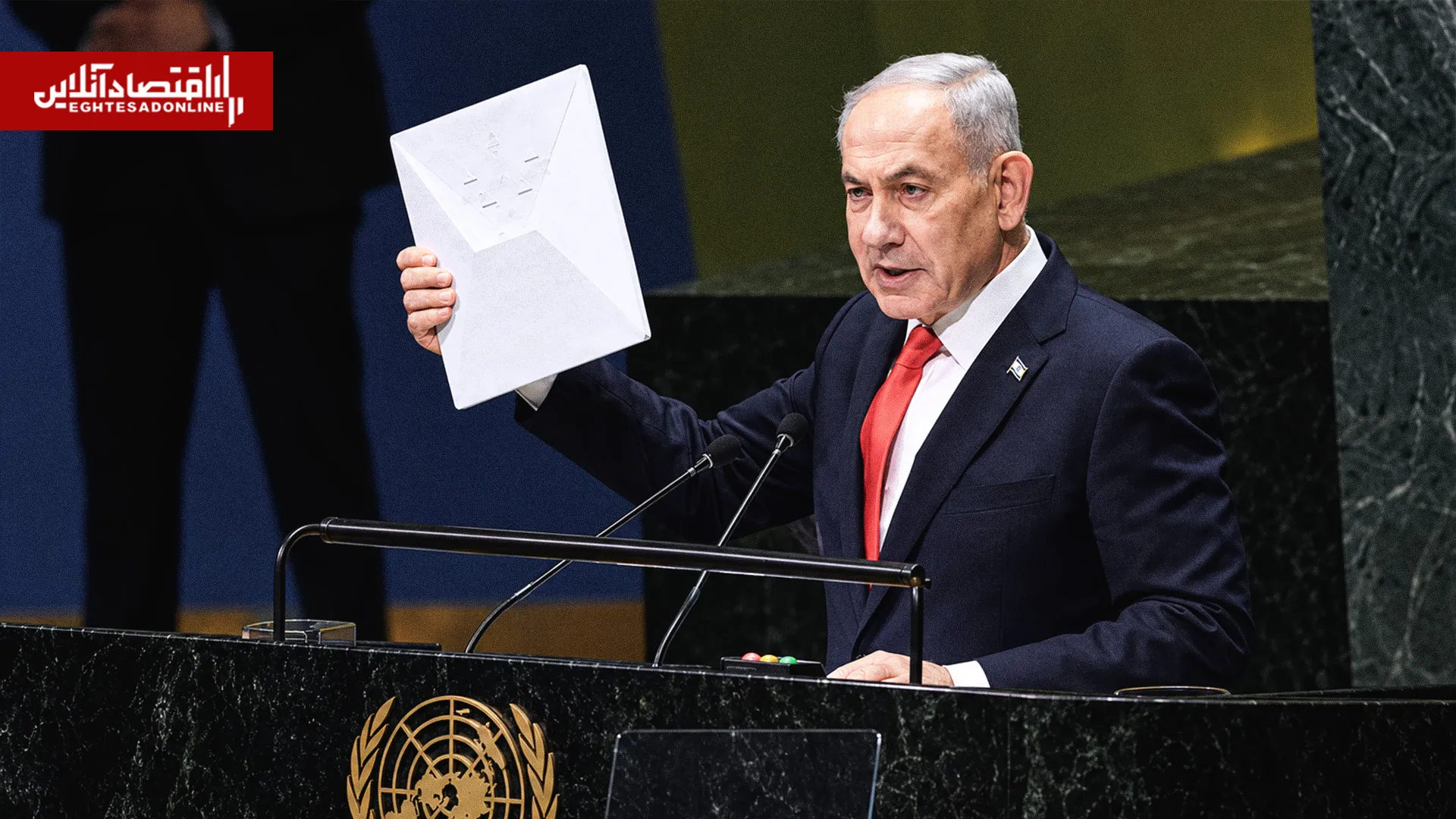
EghtesadOnIine; In his speech at the United Nations General Assembly, Israeli Prime Minister Benjamin Netanyahu held up a Starlink device instead of displaying a map or images related to Iran’s nuclear program. Netanyahu presented the device as a symbol of Iranians’ access to unrestricted internet and information.
On Thursday, September 24, 2026, Netanyahu said Starlink could allow people in Iran to access information without restrictions and freely express their views. He also claimed that the Islamic Republic spends heavily on controlling and censoring the internet because of concerns over such access.
Netanyahu went on to say that he would leave the device inside the United Nations building for the Iranian delegation. According to him, members of the delegation who “break away” from the government could use it to freely share their accounts on social media. The episode did not end there. After Netanyahu’s speech, Israel’s ambassador to the UN, Danny Danon, picked up the device, approached Nasser Asadi, a member of Iran’s delegation, and asked him to take the Starlink device back to Iran.
Asadi, however, did not respond to the offer. After turning away, he did not accept the device.
On the surface, the move could be seen as part of Israel’s political theater on the sidelines of the UN General Assembly. But Starlink has become an important part of the debate over Iranians’ access to an unrestricted internet in recent years. At the same time, revelations in recent months about efforts by Israel and the United States to get the equipment into Iran have given Netanyahu’s display greater significance.
The issue first gained renewed attention in July, when former Israeli Prime Minister Naftali Bennett provided more details about his government’s role in moving Starlink equipment into Iran. On June 23, 2026, Bennett publicly said that during his premiership, a plan had been launched to secretly purchase and transfer tens of thousands of Starlink receivers into Iran.
According to Bennett, the goal was to keep protesters connected to the internet and social media when the government cuts off internet access.
Bennett claimed, however, that Netanyahu’s government did not continue the project after his term in office ended. Netanyahu’s office did not respond at the time to Reuters’ questions about the claim, while SpaceX also declined to comment.
As a result, although the existence of the alleged plan was publicly raised by a former Israeli prime minister, details about the scale and implementation of the operation have not been independently verified.
Now, three months after Bennett’s remarks, the appearance of the same technology in Netanyahu’s hands at the United Nations has once again raised questions about whether Israel intends to make Starlink one of the tools of its policy toward Iranian society. So far, however, there has been no official announcement of a new large-scale program to transfer or distribute Starlink equipment in Iran.
Starlink’s importance in Iran increased after the nationwide protests in December 2025 and the widespread communications blackout that followed.The key difference between Starlink and conventional internet lies in how the connection is established. Instead of relying on terrestrial infrastructure and domestic telecommunications networks, Starlink terminals communicate directly with satellites in low Earth orbit. This makes completely cutting off this type of access considerably more difficult for the government.
Reuters spoke with three users inside Iran in the early days of the internet blackout who were still using Starlink. One of those users said they knew dozens of other people who had access to the network.
Several days later, activists told the Associated Press that SpaceX had waived the cost of Starlink service in Iran. Around the same period, reports emerged that more than 50,000 Starlink terminals were already in Iran. Some of the equipment was reportedly brought into the country during the 2022 “Woman, Life, Freedom” protests.
The Associated Press also reported that SpaceX had deployed a software update designed to counter Iranian government efforts to disrupt Starlink signals.
As a result, even while access to the global internet was restricted for a large portion of Iran’s population, some users equipped with Starlink were still able to send information and images outside the country.
In May 2026, Reuters reported that the administration of U.S. President Donald Trump had brought more than 6,000 Starlink terminals into Iran to help citizens access the internet following the December protests. The report cited information previously published by the Wall Street Journal.
But the issue goes beyond the transfer of terminals. According to Reuters, the Pentagon and SpaceX had also discussed using Direct-to-Cell technology in Iran. The technology can connect mobile phones directly to Starlink satellites.
If such a plan were implemented on a large scale, users would not necessarily need a Starlink ground terminal; a mobile phone could connect directly to the satellite network.
According to Reuters sources, SpaceX had requested up to $500 million to implement the project, along with $100 million per month to continue the service. The high cost of the proposal was cited as one of the issues in dispute between the company and Pentagon officials.
At the time of publication, Reuters was unable to determine whether the negotiations had ultimately resulted in an agreement./euronews